Guides / 8 min read
Qatar CV format: how to write a CV for jobs in Doha in 2026
What a CV for Doha and the rest of Qatar should include in 2026, from your QID and residence status to licences, attested degrees, length and photo, with a full example.
A CV for Qatar follows the rules of a good CV anywhere: your most recent job first, results rather than duties, and a layout that is easy to scan. What sets it apart is a short block of personal details near the top. Recruiters in Doha, Lusail and Ras Laffan want to know your nationality, whether you already live in Qatar and hold a QID, and how soon you can join, before they read your experience.
This guide covers the format employers in Qatar expect in 2026, the details that are specific to the country, what to leave off, and a complete example you can use as a model.
The Qatar CV format at a glance
- Header: full name as on your passport, target job title, +974 mobile number, email, city and LinkedIn profile, with an optional photo.
- Personal details: nationality, QID and residence status, notice period or availability, driving licence and languages.
- Profile summary: three or four lines on your role, years of experience, one or two results and when you can start.
- Work experience: most recent role first, with company, city, country and dates, and three to six achievement bullets for recent roles.
- Education: degree, university, country and year, with a note if your certificates are attested.
- Licences and certifications: your Ministry of Public Health licence, engineering registration or other professional qualifications.
- Skills: the tools, systems and methods named in the job ad.
Use A4 paper and a reverse chronological layout. Two pages is normal for experienced candidates; one page is enough for graduates and people early in their careers.
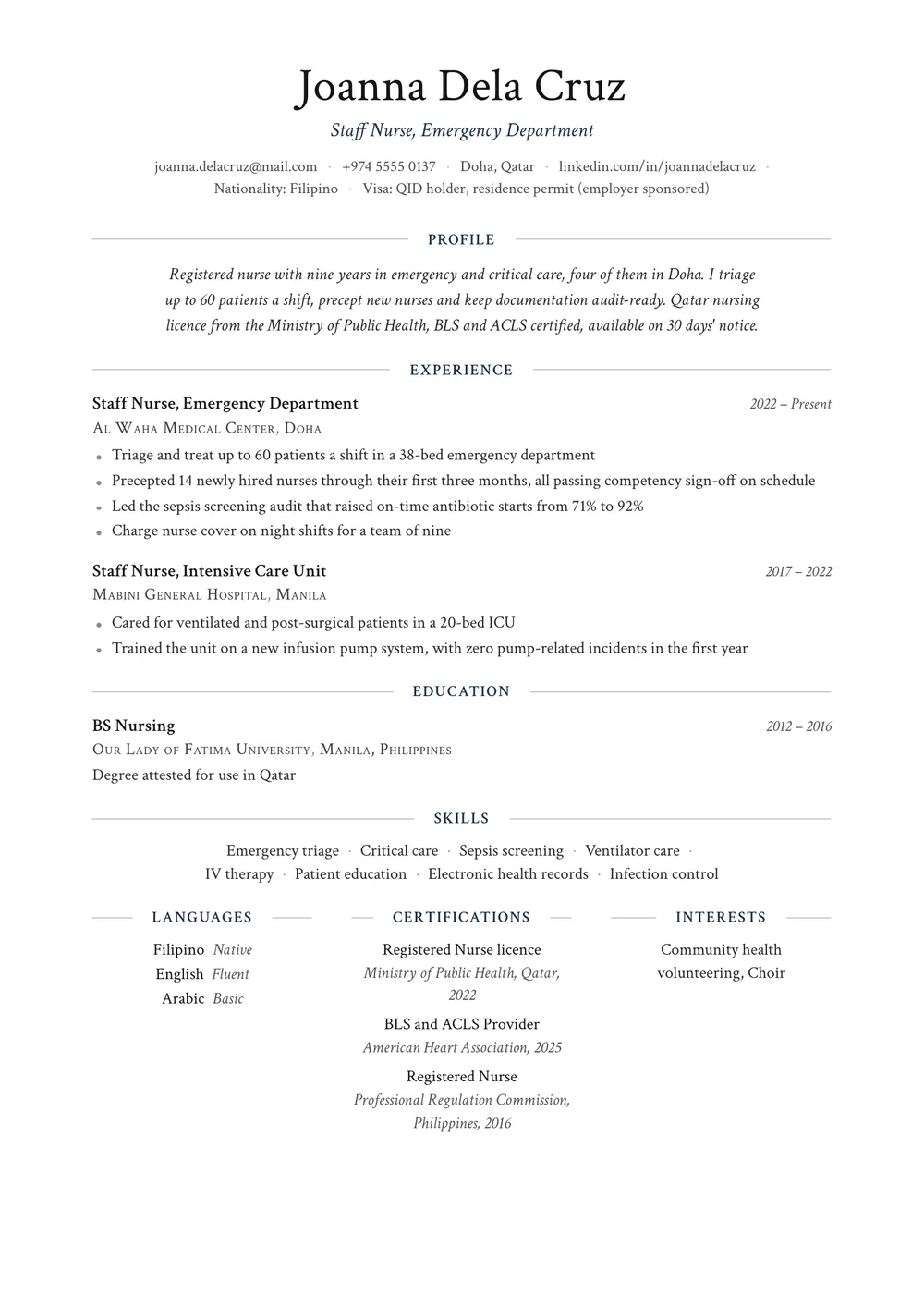
The Qatar CV maker uses A4 by default and has optional fields for nationality, residence status, driving licence and photo.
See the Qatar CV makerPersonal details recruiters in Qatar look for
Nationality
State it in one line, for example “Nationality: Indian”. Application forms in Qatar almost always ask for it, and it helps the recruiter plan the visa process. If you hold two nationalities, list both.
If you are Qatari, put it first. Qatarization programmes encourage employers, especially in energy, banking and government-linked companies, to hire and develop Qatari nationals, and recruiters often look for this before anything else.
QID and residence status
The Qatar ID, or QID, is the residence card every expatriate resident holds. Saying you have one tells the recruiter you are already in the country and can usually join sooner, and at lower cost, than someone who needs a new work visa. Keep it to one line, for example:
- Residence: QID holder, residence permit (employer sponsored)
- Residence: QID holder, family sponsored, open to a work permit
- Residence: Visit visa, in Doha until 20 December 2026
- Residence: Based in Manila, requires employment visa
Leave the QID number itself off your CV, along with your passport number. Employers collect both during onboarding, and a CV passes through many inboxes before that.
Notice period, not NOC
Older Qatar CVs often carried the line “NOC available”. In 2020 Qatar removed the general requirement for workers to get a No Objection Certificate from their employer before changing jobs, so for most people the line is no longer needed. What recruiters want to know now is your notice period: write “Notice period: 30 days” or “Available immediately”. Some groups of workers have their own rules, so check your contract before you apply.
Phone number and location
Give a Qatari mobile number in international format, such as +974 5555 0137, and your city: Doha, Lusail, Al Wakrah or Al Khor. If you are abroad, give your city and country and a number that works on WhatsApp, which many recruiters in the Gulf use for first contact.
Driving licence
List a Qatari driving licence if you hold one. For sales, field service, logistics and site roles it is often a requirement, and a line under your personal details saves a question.
Date of birth and marital status
Many CVs in Qatar still include date of birth and marital status, and some application forms ask for them. On the CV they are optional. Leave religion off.
Should you add a photo?
A photo is common on Qatar CVs and many recruiters expect one, especially in hospitality, aviation and retail. Use a recent head-and-shoulders photo in business dress against a plain background. Some multinational employers prefer CVs without photos, so leave it off when the ad asks for none.
Licences, registration and attested degrees
In regulated professions your licence status is one of the first things an employer checks, so give it its own line under certifications or in your summary.
- Healthcare: doctors, nurses, pharmacists and allied health staff need a licence from the Department of Healthcare Professions at the Ministry of Public Health, formerly known as QCHP. Write “Licensed by the Ministry of Public Health, Qatar” or “DHP licence in progress”.
- Engineering: engineers register with the Ministry of Municipality before they can practise in Qatar, a process many people still call UPDA registration. Say whether yours is done.
- Teaching and other regulated roles have their own licences, so mention yours if the job needs it.
Many employers also ask for degree certificates attested for use in Qatar as part of the work visa process. If yours are already attested, add a short note under education, as in the example above.
Writing the profile summary
Three or four lines: your role and years of experience, one or two results that match the job, and your availability. Mention Qatar or GCC experience if you have it, and Arabic if you speak it.
Example: “Registered nurse with nine years in emergency and critical care, four of them in Doha. Triage up to 60 patients a shift and led a sepsis audit that raised on-time antibiotic starts from 71% to 92%. Licensed by the Ministry of Public Health, available on 30 days' notice.”
Work experience that reads well in Qatar
List each role with title, company, city, country and dates. If an employer is not well known in Qatar, add a few words on what it does and how big it is. Then write achievements with numbers: budgets in QAR, project values, team size, volumes and turnaround times.
Large employers in Qatar, from energy and aviation to healthcare, take applications through online portals, and many use applicant tracking software to sort them. Keep standard section headings, real text rather than images, and a single PDF file.
English, Arabic or both?
English is the working language of most private-sector employers in Qatar, and an English CV is the default. Some government and semi-government employers work in Arabic, and a few ask for an Arabic CV. List Arabic with an honest level if you speak it; it helps in customer-facing, HR and government-linked roles.
Common mistakes on Qatar CVs
- No residence status, so the recruiter has to ask whether you are in Qatar.
- “NOC available” instead of a notice period.
- QID or passport numbers on the page.
- A missing or vague licence status for a regulated job.
- A casual or years-old photo.
- Duties copied from a job description instead of results.
- Four or five pages covering every job since graduation.
Build your Qatar CV with live preview and no sign-up. It is free to build and preview; you pay once, $9 for the CVFalcon Pass, when you want the PDF.
Build your CVCommon questions
Should I put my QID number on my CV?
No. Say that you hold a QID and what kind of residence permit you have, and give the number only when the employer asks for it during onboarding.
Do I still need to write “NOC available” on a Qatar CV?
Usually not. Qatar removed the general NOC requirement in 2020, so most workers can change employers after serving their notice. Write your notice period instead, and check your own contract if you are unsure.
How long should a CV be for Qatar?
Two A4 pages for experienced professionals and one page for graduates. Older roles can shrink to one line each.
Should I include a photo on a CV for Qatar?
It is common and many recruiters expect one, but it is optional. Use a recent professional headshot, or leave it off when the ad asks for no photos.
Is the Qatar CV format different from the UAE format?
Very little. Both use A4, reverse chronological order and a personal details block near the top. The differences are the residence details, a QID in Qatar and a visa status in the UAE, and the bodies that license regulated jobs.
Keep reading
- CV format for UAE jobs in 2026: what Dubai and Abu Dhabi recruiters expectWhat a CV for Dubai, Abu Dhabi and the rest of the UAE should look like in 2026, from the personal details recruiters check first to length, photo and languages.
- Saudi CV format: how to write a CV for jobs in Saudi ArabiaWhat a CV for Riyadh, Jeddah and the Eastern Province should include, from iqama status and name spelling to professional accreditation and length.
- Kuwait CV format: how to write a CV for jobs in Kuwait in 2026What a CV for Kuwait should include in 2026, from your residence article and civil ID to accreditation, driving licence, length and photo, with a full sample CV.